Tufted Ground Squirrel Rheithrosciurus macrotis
Tufted Ground Squirrel Rheithrosciurus macrotis
Vulnerable
Extant (resident)
Malaysia, Brunei, Indonesia (Borneo).
The tufted ground squirrel, or groove-toothed squirrel, is a striking nut-cracking rodent native to the island of Borneo. Sporting a voluminous, club-shaped tail, the tufted ground squirrel carries the largest tail-to-body size ratio of any mammal. Scientists believe the tail could serve to confuse predators or attract mates. They are listed as Vulnerable on the IUCN Red List and are threatened by deforestation, hunting, and forest conversion to palm oil. To protect these charismatic creatures, make sure you #BoycottPalmOil and #Boycott4Wildlife in the supermarket!
With the most magnificent tail of all in the #jungle, the #vulnerable Tufted Ground Squirrel of #Borneo 🇲🇾🇮🇩 is losing a battle against #palmoil #ecocide. Fight for them when you shop and be #vegan 🥕🥦🍆 #Boycottpalmoil #Boycott4Wildlife @palmoildetect wp.me/pcFhgU-7P9
Share to BlueSky
Share to Twitter
Mistaken as ‘vampire squirrels’ 🧛🦷 for their sharp teeth, Tufted Ground #Squirrels only eat nuts. They are vulnerable in #Indonesia and #Malaysia from #palmoil #deforestation. Help them survive! #Boycottpalmoil 🌴🪔🤮⛔️ #Boycott4Wildlife @palmoildetect wp.me/pcFhgU-7P9
Share to BlueSky
Share to Twitter
Appearance & Behaviour
The tufted ground squirrel, or groove-toothed squirrel, is a striking nut-cracking rodent native to the island of Borneo. Weighing in at around 2 kg their bodies are overshadowed by a fluffy, charcoal-and-white frosted tail that’s 130% the volume of their body. Their head-and-body length is around 34 cm with a tail almost as long, bringing their total length to nearly 70 cm! They have the largest tail-to-body ratio of any animal on the planet.
Their sharp incisors feature 7-10 saw-like grooves that are perfect for cracking hard nuts. Their fur is primarily brown with a reddish tint, and they sport dramatic tufts of dark fur on their ears, giving them a striking appearance. They’re agile climbers and forage both on the forest floor and in the lower canopy.
- “Vampire Squirrel” myth is patently untrue: Though local folklore suggests that these squirrels attack deer from above to feast on their organs, researchers have yet to find scientific proof. Instead, they mostly munch on incredibly hard seeds, especially those from the Canarium tree.


Threats
- Deforestation: Conversion of their habitat into monoculture plantations like palm oil is a major threat.
- Logging: Out of control logging practices impact their primary forest habitat.
- Hunting and Trapping: Although not specifically targeted, these squirrels can become victims due to their ground-foraging habits.
You can help spread awareness about impacts of palm oil on these squirrels and 1000’s of other species. By using your wallet as a weapon every time you shop and being a part of the #BoycottPalmOil #Boycott4Wildlife you are taking an empowering step for them.


Habitat
Glimpsing Tufted Ground Squirrels in their natural home is exceedingly rate. They are found only on the island of Borneo and prefer dense lowland primary forests up to 1,100 meters in elevation. However, they will sometimes venture into secondary forests, orchards or smallholdings. They are elusive and not often seen, sometimes their fluffy tailed forms are captured by camera traps or chance sightings.
Diet
The tufted ground squirrel’s diet includes mostly hard seeds, particularly those of the Canarium tree. They also eat fruits, nuts, and insects, adapting to the available food sources in their forest habitat. Despite their sharp teeth, tales of their carnivorous nature have led to them being dubbed “vampire squirrels”, however these claims were subsequently discovered to be lacking in evidence. Their ultra sharp teeth give them the ability crack open even the toughest nuts.
Mating and breeding
Much remains unknown about the mating and reproduction of the tufted ground squirrel due to their elusive nature. Researchers hope that future studies using motion-activated cameras will uncover more details about their behaviour, including how their elaborate tail might play a role in courtship.
Support Tufted Ground Squirrel by going vegan and boycotting palm oil in the supermarket, it’s the #Boycott4Wildlife
Support the conservation of this species
This animal has no protections in place. Read about other forgotten species here. Create art to support this forgotten animal or raise awareness about them by sharing this post and using the #Boycottpalmoil #Boycott4Wildlife hashtags on social media. Also you can boycott palm oil in the supermarket.
Further Information
Animalia. (n.d.). Tufted ground squirrel: Groove-toothed squirrel. animalia.bio/tufted-ground-squ…
Meijaard, E. 2016. Rheithrosciurus macrotis. The IUCN Red List of Threatened Species 2016: e.T19474A22248783. dx.doi.org/10.2305/IUCN.UK.201…. Accessed on 08 May 2024.
Pare, S. (2023, December 24). Tufted ground squirrel: The Borneo rodent once believed to disembowel deer and feast on their organs. livescience.com/animals/land-m…
Stokstad, E. (2015, September 2). ‘Vampire’ squirrel caught on film: Researchers in Borneo get first video of mammal with fluffiest tail. science.org/content/article/va…
Wikipedia. (n.d.). Tufted ground squirrel. en.wikipedia.org/wiki/Tufted_g…


How can I help the #Boycott4Wildlife?
Take Action in Five Ways
1. Join the #Boycott4Wildlife on social media and subscribe to stay in the loop: Share posts from this website to your own network on Twitter, Mastadon, Instagram, Facebook and Youtube using the hashtags #Boycottpalmoil #Boycott4Wildlife.
2. Contribute stories: Academics, conservationists, scientists, indigenous rights advocates and animal rights advocates working to expose the corruption of the palm oil industry or to save animals can contribute stories to the website.

Wildlife Artist Juanchi Pérez

Mel Lumby: Dedicated Devotee to Borneo’s Living Beings

Anthropologist and Author Dr Sophie Chao

Health Physician Dr Evan Allen

The World’s Most Loved Cup: A Social, Ethical & Environmental History of Coffee by Aviary Doert

How do we stop the world’s ecosystems from going into a death spiral? A #SteadyState Economy
3. Supermarket sleuthing: Next time you’re in the supermarket, take photos of products containing palm oil. Share these to social media along with the hashtags to call out the greenwashing and ecocide of the brands who use palm oil. You can also take photos of palm oil free products and congratulate brands when they go palm oil free.
twitter.com/CuriousApe4/status…
twitter.com/PhillDixon1/status…
twitter.com/mugabe139/status/1…
4. Take to the streets: Get in touch with Palm Oil Detectives to find out more.
5. Donate: Make a one-off or monthly donation to Palm Oil Detectives as a way of saying thank you and to help pay for ongoing running costs of the website and social media campaigns. Donate here
Learn about other animals endangered by palm oil and other agriculture
Global
South America
S.E. Asia
India
Africa
West Papua & PNG

Sunda Clouded Leopard Neofelis diardi

Glaucous Macaw Anodorhynchus glaucus

Attenborough’s Long-Beaked Echidna Zaglossus attenboroughi

Nancy Ma’s Night Monkey Aotus nancymaae

Maned Wolf Chrysocyon brachyurus

Visayan Broadbill Sarcophanops samarensis
Learn about “sustainable” palm oil greenwashing
Read more about RSPO greenwashing
Lying
Fake labels
Indigenous Land-grabbing
Human rights abuses
Deforestation
Human health hazards
A 2019 World Health Organisation (WHO) report into the palm oil industry and RSPO finds extensive greenwashing of palm oil deforestation and the murder of endangered animals (i.e. biodiversity loss)


#animals #Borneo #Boycott4wildlife #BoycottPalmOil #Brunei #deforestation #ecocide #ForgottenAnimals #hunting #Indonesia #jungle #Malaysia #Mammal #PalmOil #palmOilDeforestation #palmoil #rodent #rodents #SouthEastAsia #Squirrels #TuftedGroundSquirrelRheithrosciurusMacrotis #vegan #vulnerable #VulnerableSpecies
Palm Oil Detectives | Auckland
Palm Oil Detectives, Auckland. Gefällt 610 Mal · 15 Personen sprechen darüber. A collective of like-minded artists, writers, photographers, musicians and wildlife conservationists who share and...www.facebook.com

Mel Lumby: Dedicated Devotee to Borneo’s Living Beings
Retired Horticulturalist Mel Lumby: In Her Own Words
The beautiful begonias of Borneo and beyond deserve our love and protection
Bio: Mel Lumby
Hello, I’m Melody Lumby from the US state of Oregon. Throughout my career and life (over 50 years) I have been a passionate devotee of plants and a horticulturalist. Prior to retiring, I was a horticultural buyer for a retail nursery business and a lab technician in a horticultural laboratory, testing soil amendments and soil media for quality assurance.
I have always loved Begonias. I have loved them since falling for them at age 16 when I joined the American Begonia Society in Portland, Oregon – I am still a member!
When I first joined, it was me and a bevvy of sweet grannies and together we gathered to discuss and marvel over these plants.
Now after 50 years of living with, working with and loving begonias – I’m the one with the grey hair!
I’ve seen begonias go in and out of fashion over this time.
“Oh, yes. Begonias are a little old lady plant,” they used to say….now look at them!
Begonias are no longer citizens of Dorkville. They are coveted and collected by the hip and ‘planty’
Begonias are greatly coveted by hobbyists and are shown off on social media by hip and ‘planty’ enthusiasts.I used to pay around $3.99 USD for certain begonias. Now? Some folks will pay $399 USD for unusual and desirable species of Begonia. Sometimes it can be even more expensive than that.
Begonias have been with me through the decades, a lovely silent friend to come home to after work, during life’s trials and joys, a beautiful accompaniment to a happy life.~ Mel Lumby
Hidden in the jungles of SE Asia, scientists estimate that there are undiscovered begonia species to the tune of three to five hundred new species on Papua New Guinea. They occupy shady forest floors and limestone cliffs, without any name given by human kind. Horticultural commerce hasn’t had a glimpse of them yet.
On Borneo, it is estimated that 400 possibly even more species of Begonia exist – primarily in the under surveyed Kalimantan district.Begonias, along with orangutans and many other rainforest inhabitants are in danger now. Will these precious jewels of the jungle be located by scientists, described, eventually named and shared, so that people can love and marvel at their incredible beauty? Or will the bulldozer get there first, destroying where they live, making way to plant oil palm plantations for cheap palm oil?
[Pictured] Begonia Rex, National Gallery of Canada (1868)
Come on an enchanting and curious journey into of the world’s most beautiful, medicinal and endangered plants of the rainforest: #Begonias with retired horticulturalist Mel Lumby @[url=https://mastodon.social/users/Norska11]Norska11[/url] #Boycott4Wildlife #BoycottpalmoilWill exquisite #begonias become historical relics…no longer found in real life #rainforests? Not if Begonia lover Mel Lumby @[url=https://mastodon.social/users/Norska11]Norska11[/url] has anything to do with it! Help her fight for rare plants #Boycottpalmoil #Boycott4Wildlife
Beautiful #begonias are the unsung heroes of #rainforests. Their supreme beauty dazzles us. Their medicine protects us. Yet #corporate greed threatens them. By Horticulturalist Mel Lumby @[url=https://mastodon.social/users/Norska11]Norska11[/url] #Boycottpalmoil #Boycott4Wildlife
Download image
Download printable PDF
View interactive HTMLWe buy inexpensive products that contain palm oil now. It is a cheap, useful, oil that manufacturers like to use. Cookies, crackers, frozen pizza, shampoo, face lotion.
We buy these products without realising that we are contributing to rainforest destruction. Those rainforest shady places where beautiful Begonias grow are vulnerable to deforestation for palmoil.
“We are destroying swathes of rainforest containing beautiful, jewel-like, treasures. I cannot sit by quietly, while our beautiful earth burns. I must act!”
“I thought that I would quietly retire at the beach, grow a flower garden and happily live out my days with my chickens. I have done this. But I cannot be silent. I am now adding my voice to many others who are trying to save the animals and plants we love from mass extinction. I am only one person, but I can do something.”Mel lumby
Mel Lumby on Instagram: More begonias being carefully, lovingly grown
Mel Lumby’s Begonia moysesii in bloom
Mel Lumby’s Instagram: Evey Big Buff and Eloise Little Miss, two of my buddies hanging out in the garden bed.
Photos: Mel Lumby on Instagram @spock_like_object“I am able to help fight against the greed of palm oil. This feels so good!”
This issue has been on my mind for quite some time now.It really bothers me that there are beautiful undiscovered begonias that took millions of years to evolve.
We won’t even get to know about them because of dumb old palm oil!
Nobody even asked for this in our food, etc. The Palm Oil Detectives gal is really a cool person – it is an honour to try to help her.
~ Mel Lumby
Palm Oil and Pollution by Jo Frederiks
Deforestation for agriculture is a clear and present threat to tropical rainforests. Especially in Indonesia and Malaysia, economic growth has come at an enormous cost to its unique plants, wild animals and indigenous peoples.
In Indonesia, 10 million hectares of primary forest was lost over the past two decades. A 2019 study identified palm oil plantations to be responsible for 23% (the single largest proportion) of the deforestation in Indonesia between 2001 and 2016.
Over 3 million hectares of the forest estate in 2019 were allocated to palm oil production, which was in strict violation of national forestry law.
It is gut-wrenching and soul-destroying to see. Now palm oil threatens plants, animals and indigenous peoples in South America, India, Papua and Africa as well.
Fast facts about Borneo & plant diversity
Borneo is home to more than 15,000 plant species
A diversity that rivals the African continent. This may be the highest number of plants of any region on Earth.
- There are 931 Begonia species in Southeast Asia
- Currently, there are 216 species and one subspecies of Begonia in Borneo.
- In Sarawak alone there are 96 species, with an average of at least 10 species described per year over the past 7 years.
- In Borneo, there are also 3,000 species of trees, 1,700 species of orchids and 50 carnivorous pitcher plant species.
The natural habitat of begonias is cool, moist forests and tropical rainforests, but some begonias are adapted to drier climates
[Pictured] Begonia socotrana grows in between the shady cracks in rock formations on the arid island of Socotra, Yemen.Fast facts about the family Begoniaceae
They grow in the deeply shaded forest understory from the lowlands to mountain tops and on all rock types including granite, limestone, sandstone and ultramafic rocks.A Guide to Begonias of Borneo by Ruth Kiew et. al.
- The Begonia was named after a French botanist in the 17th century.
- There are over 2,000 known species of family Begoniaceae – one of the largest genera of flowering plants. New species are being discovered almost on a monthly basis.
- They are mostly terrestrial and are either herbs or undershrubs, but occasionally may be grown from air (ephiphytic).
- They thrive in moist tropical and subtropical climates of South and Central America, Africa and southern Asia.
- Their leaves are often large, vividly marked and are they are assymetrical and unequal-sided, giving each plant unique beauty.
- They are popular ornamental plants for conservatories. Currently, begonias are incredibly trendy and are coveted and admired by house plant lovers all over the world.
[Pictured] Begonia Rex, National Gallery of Canada (1868)
The world’s tiniest begonia was recently discovered Begonia elachista.They exist at the mouth of a limestone cave in central Peru and nowhere else in the world.
Then there is a newly described giant begonia from Tibet, tall enough to tower over a person: Begonia giganticaulis.
The pretty Florist’s Reiger Begonia comes in a fantastic array of colours including pinks, peaches, oranges, reds, yellows, white.
We cannot forget the lovely tuberous begonias that we plant in the shady reaches of our yards.
To plant large flowerbeds full of Wax begonias in summertime is a sheer delight.
During drought periods, Begonia socotrana drop their pretty, round, leaves and survive as a tuber.
Many years ago, Begonia socotrana was used as one of the parent plants to eventually create Florist’s Reiger Begonia mentioned above.
Mel Lumby
Exceptionally beautiful begonia paintings from history
Those lovely plants are there, for now, surrounded by tropical bird call and orangutan hoots. They often live in very small stretches of area, sometimes only existing on one hillside and nowhere else in the world. Plants can’t run away if that bulldozer comes, they are sessile, fixed in one place.If a bulldozer razes everything and scrapes that Begonia inhabited hillside bare, that’s it – that particular begonia will be lost, gone forever from our earth in the wild. Millions of years of evolution, gone. All that beauty, gone.
Mel Lumby
[Pictured] ‘Diversity of Species in the Rainforest by Oro Verde – the Rainforest Foundation (2009).Scientists are constantly discovering new Begonia species in Indonesia
Indonesia has one of the largest concentrations of of begonia species diversity, especially in Southeast Asia with 243 species. In 2022 alone, at least a dozen new species were discovered, here in this article below, seven are mentioned.
- Hoya batutikarensis
- Hoya buntokensis
- Dendrobium dedeksantosoi
- Rigiolepis argentii
- Begonia robii
- Begonia willemii
- Etlingera comosa
Read the full story: ‘Indonesian researchers discover seven new species of ornamental plants,’ Indonesian Window.
Indonesia is an archipelago consisting of approximately 17,508 islands and is covered by tropical rain forest, seasonal forest, mountain vegetation, subalpine shrub vegetation, swamp and coastal vegetation. With its reflective mixture of Asian and Australian native species,
Indonesia is said to possess the second largest biodiversity
in the world, with around 40,000 endemic plant species
including 6,000 medicinal plantsNugraha, Ari S, et. al (2011) . ‘Revealing Indigenous Indonesian Traditional Medicine: Anti-infective Agents’, Natural Product Communications. journals.sagepub.com/doi/pdf/1…
We may be losing plants with medicinal purposes and cures as yet unknown which will help humankind
If we bulldoze Borneo, plow down Papua New Guinea, annihilate the Amazon, we wipe out incredibly beautiful plants that haven’t yet been discovered!It isn’t just Begonias. It’s orchids and all sorts of fascinating tropical plant species. Nepenthes, the pitcher plant species. Aroids – the wonderful Philodendron relatives of Begonias that are also popular now.
Mel Lumby
Newly discovered Begonia medicinalis has cancer-fighting properties
Begonia medicinalis was discovered only recently in 2019 by scientists. This incredible species of begonia native to Sulawesi has been used as a medicinal plant by Indigenous peoples for 1000’s of years. Now this plant has been shown to have the potential to fight cancer!Begonia medicinalis is known as benalu batu in Bahasa Indonesia is a herbal plant that is locally used for traditional medicines. The secondary metabolites such as flavonoids, alkaloids, steroids, and terpenoids have been reported to be found in these plant extracts. The content of flavonoids can lead to anti-cancer abilities while heat-sensitive flavonoid compounds can be extracted by the Ultrasound-assisted Extraction (UAE) method.In this study, the anticancer potential of B. medicinalis extracts from the leaves (leaves extract/LE) and stem (stem extract/SE) in three cell lines (Hela, MDA-MB, HT-29) have been performed.
The anticancer potential was obtained from cytotoxic measurements by the MTT method on 3 types of cancer cells incubated with the extract for 24 hours. The value of total flavonoid content (TFC) in the LE was higher than that of SE extracts. Both extracts have the potential as a remedy for the treatment of cancer.
Prihardina & S Fatmawati; (2021); ‘Cytotoxicity of Begonia medicinalis aqueous extract in three cancer cell line,’: IOP Conf. Ser.: Earth Environ. Sci. 913 012084. iopscience.iop.org/article/10.…
Begonia isoptera is used by indigenous peoples in Borneo and has profoundly important medicinal properties
http://tropicalflowers.la.coocan.jp/Begoniaceae/Begonia%20isoptera/DSC01021.JPG" title="Begonia Isoptera in Hiroshima Botanical Gardens 2008. http://tropicalflowers.la.coocan.jp/Begoniaceae/Begonia%20isoptera/DSC01021.JPG" class="has-alt-description">
This Begonia species found in Borneo has been used by indigenous peoples for aeons for medicinal purposes. A study from 2011 has found that this begonia species has positive antimicrobial and antibacterial effects on the human body.
[Pictured] Begonia Isoptera in Hiroshima Botanical Gardens 2008Read more: Nugraha, Ari S, et. al (2011) . ‘Revealing Indigenous Indonesian Traditional Medicine: Anti-infective Agents’, Natural Product Communications. journals.sagepub.com/doi/pdf/1…
Indonesia’s native plants: A medicine cabinet of powerful drugs growing in the rainforest
Indigenous peoples in Indonesia have been using native medicinal plants from their medicine cabinet – the rainforest for 1000’s of years. These medicines are influenced by Indian Ayurveda since Hinduism spread from India to Asia.
[Pictured]: Dyak/Dayak peoples in Borneo have a rich knowledge of ancient plant medicine that is recognised by western science. Images from PxFuel, creative commons.
Indigenous treatments using plants involve a combination of physical and spiritual aspects to form a holistic approach to healing.
The inclusion of indigenous medicinal plants not found in India enhanced Indigenous Indonesian medication. This was further enriched by the influence of Chinese and Arabian traders to the islands.
Dayak indigenous peoples of Borneo are knowledge-keepers of ancient indigenous medicine and treatment from plants. This knowledge is passed down from generation to generation. Now western medicine is realising just how important it is to keep these plants from going extinct. Research shows that these plants may hold the key to unlocking fatal diseases like dementia and cancer, as well as being useful for treating common illnesses and injuries.
Most of this indigenous knowledge of medicine is not recorded. It is passed down verbally in stories from generation to generation and healer to healer.
Dayak Indigenous Ethnographer Dr Setia Budhi: In His Own Words
“For Dayak peoples in Borneo, the land is mother, where they plant fruit, vegetables and grains for their families. The soil is mother where trees grow and develop.“From these trees they harvest an abundance of creeping rattan for medicine, food and crafts.
“The forest has a ritual function, a medicinal function and a family protection function.”
Dr Setia Budhi, Dayak Ethnographer.
Interview with Dr Budhi
Short story by Dr Budhi
Historically, Dutch colonialists of Indonesia incorporated elements of indigenous medicine into their treatments, due to lack of availability of western medicine from the 17th to the 19th centuries. Medical texts from this period show that physicians found traditional medicines to be legitimate and effective in treating common illnesses. These publications include:
- De medicina Indorum by Bontius in 1642
- The Ambonese herbal by Rumphius in 1741
- Materia Indica by van der Burg in 1885
- De nuttige planten van Nederlansch Indie by Heyne in 1927
- Select Indonesian medicinal plants by Steenis Kruseman in 1953
- The Medical Journal of the Dutch East-Indies (1894- 1925)
[Pictured] Dutch colonialists overseeing the local workers in a warehouse in Deli Medan North Sumatra, 1897. www.nationaalarchief.nl
Since the 1970’s, the use of lab-based equipment, technology and computational modelling has revealed the remarkable properties of Indonesian rainforest plants, which have anti-viral, anti-malarial, anti-bacterial and anti-fungal agents within them.
Read more
The wonder drugs of the rainforest: Nugraha, Ari S, et. al (2011) . ‘Revealing Indigenous Indonesian Traditional Medicine: Anti-infective Agents’, Natural Product Communications.Professor Budiman Minasny; ‘The dark history of slavery and racism in Indonesia during the Dutch colonial period’ (2020), University of Sydney, The Conversation.
This is what stands to be lost if more rainforests are destroyed for timber and palm oil in SE Asia, Papua, Africa and South America
“I can’t only be a begonia collector/grower anymore. Boycotts work to shift brands to act when governments fail to act” ~ Mel Lumby
Please join me and a growing number of people around the world who love nature, rainforests, animals and plants and who make an effort daily to push back against the corrupt and greedy people funded by the palm oil industry to spread greenwashing misinformation about “sustainable” palm oil.
Together we can use our wallets as weapons, #Boycottpalmoil and #Boycott4Wildlife” ~ Mel Lumby
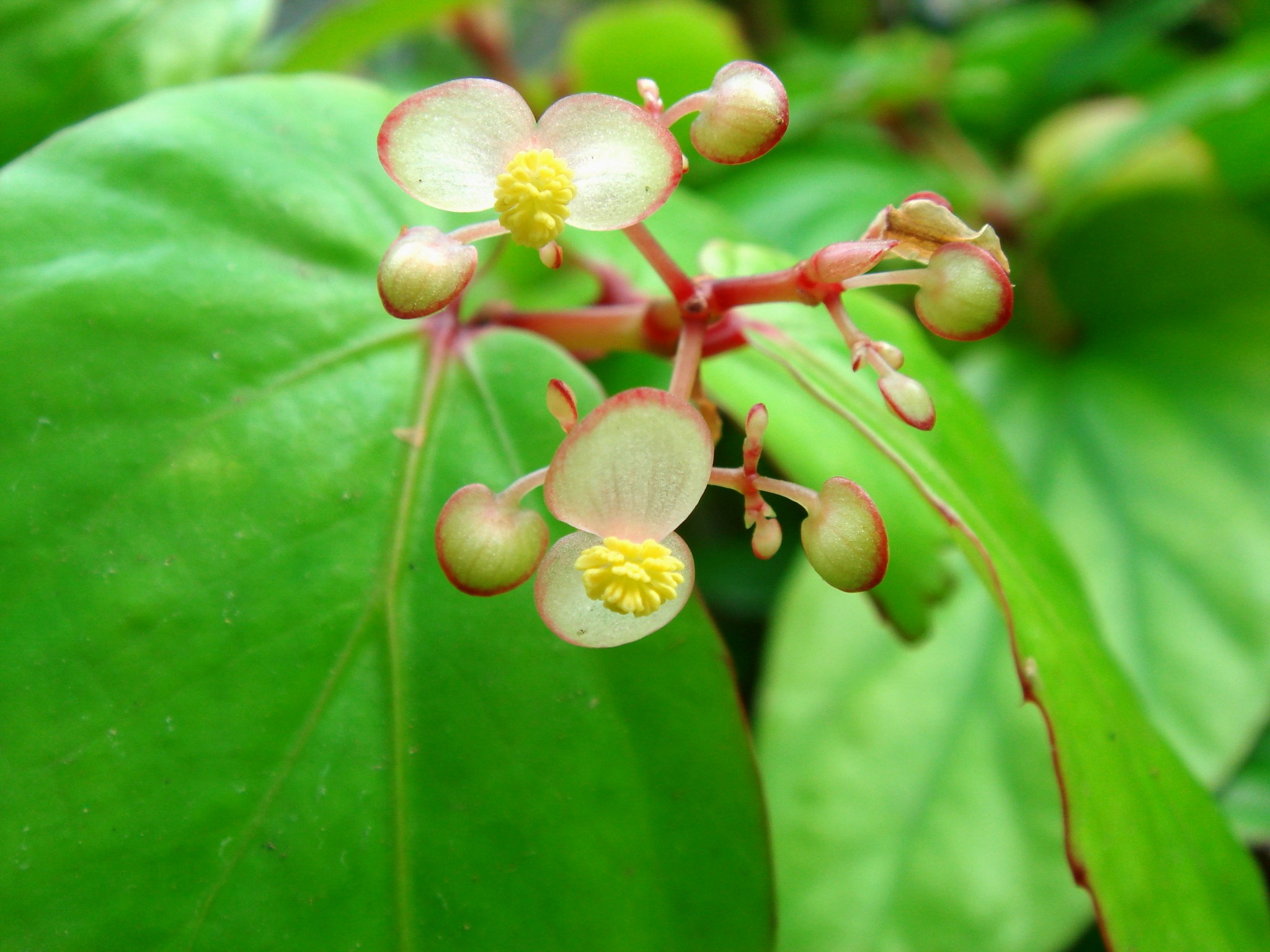
Begonias in blossom by Freepix
Borneo is in great danger of being destroyed by deforestation to plant palm oil plantations.
Other places as well: Papua New Guinea, The Amazon, African countries like Guinea. You have seen the news. Our world is in trouble.
There are places with undiscovered endemic plant species with very limited habitats being bulldozed, burned and cut down. Science hasn’t even found these plants! We chop down their only habitat before they get discovered!
Amazing new Begonia species are being discovered all the time in Borneo: Begonia baik, Begonia darthvaderiana, Begonia nothobarimensis. And on and on. Scientists are still finding new and wonderful species there.
It’s super easy to get into a nihilist mindset these days
“It is a struggle and depressing when one realises how everything in the natural world is set up to be used, abused and destroyed – simply for profit!“We have all been through ‘some things’ these last few years, that’s for sure! I just focus, concentrate and keep going. When it all gets too much, I take a couple of days to chill. Then I begin again with campaigning against tropical deforestation and against palm oil.”
Mel Lumby
The regal and rare Begonia rajah
Begonia rajah is a species of flowering plant in the family Begoniaceae, native to Peninsular Malaysia. They typically have striking bronze leaves and contrasting green veins, and are best suited for terrariums.Watercolour painting of Begonia rajah of an original wild-collected plant grown in the Botanic Gardens, Singapore via Singapore Botanic Gardens.
Begonia coriacea is a species native to Indonesia
Begonia coriacea – Hooker – Curtis Botanical Magazine Bot. Mag. 78 t. 4676 (1852)
Stinky meat flowers of Borneo: Rafflesia arnoldii & Rafflesia pricei
Borneo is also home to the largest flower in the world, Rafflesia arnoldii. They along with their relatives, are parasites, living their entire lives inside of tropical vines. These amazing plants only ever emerge when it is time to flower and flower they do! Their superficial resemblance to a rotting carcass goes much deeper than looks alone. These flowers give off a fetid odour of rotting flesh that is proportional to their size, but not to their visual beauty. This aroma has earned them the nickname “carrion flowers.”
Rafflesia pricei by Rimbawan on Getty Images
Rafflesia arnoldsii by Boris 25 on Getty Images
12 new species of begonia were found on Sarawak in 2022
Twelve new species and one new record of Begonia (Begoniaceae) from Sarawak, Malaysia, are described. All species belong to Begonia sect. Petermannia. Three species are recorded from Totally Protected Areas, one species occurs both within and outside Totally Protected Areas, and eight species occur only outside Totally Protected Areas.Edinburgh Journal of Botany, Begonia special issue, Article 410: 1–46 (2022). https://doi.org/10.24823/EJB.2022.410.
Different species of Begonia by Botanicus botanicus.org
“Polka-dotted. Striped. Furry. Shiny. Bumpy. Ferny. Maple-shaped. Elm-shaped. Grass-shaped. Black, silver, pink, mossy green and bright apple green leaf colors. Reds and oranges, too. Some will shine in the deep forest, with a beautiful blue sheen. The variety of Begonias is incredible!”Mel Lumby
If you can successfully grow a Darth Vader Begonia – consider yourself a badass
https://www.lyasolisblog.ie/home/flora/begonia-darthvaderiana-care" title="Begonia Darthvaderiana By Lya Solis Blog https://www.lyasolisblog.ie/home/flora/begonia-darthvaderiana-care" class="has-alt-description">
Begonia darthvaderiana
- Discovered in 2013 by C.W. Lin, S.W. Chung and C.I. Peng and found in Sarawak, Borneo and found in shaded valleys, streams and slopes.
- Not a beginners begonia, this one is challenging to grow. They need a humid terrarium environment. Even then, their leaves are prone to ‘melting’ if temperatures, humidity waver too much from what they like.
- This beautiful species has a cane-like habit, olive black leaves and red colouring underneath, with a white to lime green edging.
[Pictured] Begonia Darthvaderiana By Lya Solis Blog
Begonia amphioxus: Polka-dotted princess
https://www.lyasolisblog.ie/home/flora/begonia-amphioxus" title="Begonia amphioxus by Lya Solis Blog https://www.lyasolisblog.ie/home/flora/begonia-amphioxus" class="has-alt-description">
- Begonia amphioxus was discovered in 1984 growing on a limestone hill of Batu Punggul in Sabah, Borneo.
- Their red polka dots, bizarre and narrow leaves and pointed at both ends give this species an unusual look.
- This delicate looking begonia not only has aesthetic appeal but also commercial value and are highly collectable by plant hobbyists.
- They love high humidity and require a terrarium to grow. Once happy they will produce tiny white flowers.
- Threats in the wild include timber logging, palm oil, mining and quarrying for limestone and marble. Fires, droughts and extreme weather due to climate change along with tourist activities.
[Pictured] Begonia amphioxus by Lya Solis Blog
Every animal species in Borneo relies on native plants, including humans! So it’s about time we look after Borneo’s plants – because they look after us all!
Without direct intervention in Borneo’s national parks to protect plants and animals: Everyone from orchids and orangutans, begonias and binturongs will go extinct!
[Pictured] A critically endangered Sumatran orangutan by Craig Jones Wildlife Photography
When wildlife photographer and photojournalist Craig Jones visited Sumatra, Indonesia he found protected rainforests being destroyed by multinational palm oil companies – under the greenwashing guise of “sustainable” RSPO palm oil.
Craig Jones in his own words
Eyewitness: Orangutans are rescued from an RSPO plantation
Here are some other ways you can help by using your wallet as a weapon and joining the #Boycott4Wildlife
What is greenwashing?
Why join the #Boycott4Wildlife?
Greenwashing Tactic #4: Fake Labels
The Counterpunch: Consumer Solutions To Fight Extinction
Contribute to my Ko-Fi
Did you enjoy visiting this website?
Palm Oil Detectives is 100% self-funded
Palm Oil Detectives is completely self-funded by its creator. All hosting and website fees and investigations into brands are self-funded by the creator of this online movement. If you like what I am doing, you and would like me to help meet costs, please send Palm Oil Detectives a thanks on Ko-Fi.
Dorias Tree Kangaroo Dendrolagus dorianus
Giant Ground Pangolin Manis gigantea
Borneo Pygmy Elephant Elephas maximus borneensis
Bornean Peacock-pheasant Polyplectron schleiermacheri
Photography: Craig Jones Wildlife Photography, Wikipedia, Getty Images, PXFuel.
Words: Mel Lumby, Palm Oil Detectives, Dr Setia Budhi, Craig Jones.
Contribute to my Ko-Fi
Did you enjoy visiting this website?
Palm Oil Detectives is 100% self-funded
Palm Oil Detectives is completely self-funded by its creator. All hosting and website fees and investigations into brands are self-funded by the creator of this online movement. If you like what I am doing, you and would like me to help meet costs, please send Palm Oil Detectives a thanks on Ko-Fi.
#Borneo #Botany #conservation #CreativesForCoolCreatures #Dayak #deforestation #endangeredPlants #flora #indigenousMedicine #indigenousRights #investigativeJournalism #journalism #Malaysia #PalmOil #palmOilDeforestation #plants #wildlife #wildlifeActivism
Eyewitness by Craig Jones: A mother and baby orangutan are rescued from an RSPO palm oil plantation in Sumatra
Craig Jones: Eyewitness Wildlife Photographer and Conservationist Bio: Craig Jones One of Britain’s finest wildlife photographers, Craig Jones is also one of the most humble and down-to-earth guys …Palm Oil Detectives


![[Pictured] Begonia socotrana grows in between the shady cracks in rock formations on the arid island of Socotra, Yemen.](https://friendica.world/photo/link/200088 "[Pictured] Begonia socotrana grows in between the shady cracks in rock formations on the arid island of Socotra, Yemen.")


![[Pictured] 'Diverse Species of the Rainforest by Oro Verde - the Rainforest Foundation (2009).](https://friendica.world/photo/link/200089 "[Pictured] 'Diverse Species of the Rainforest by Oro Verde - the Rainforest Foundation (2009).")


![[Pictured] A critically endangered Sumatran orangutan by Craig Jones Wildlife Photography](https://friendica.world/photo/link/200090 "[Pictured] A critically endangered Sumatran orangutan by Craig Jones Wildlife Photography")